
Access to approved mobile numbers
Route defined inbound cellular calls to the PBX or SIP platform.
Products
Every OpenVox product line, from PBX systems to gateways and accessories.
View all 184 productsIPPBX and phones
Cards and accessories
Connect my sites
Modernize what I have
Integrate approved cellular voice traffic into the contact center environment so that inbound, outbound, regional, or backup calls can follow defined routing, agent, and recording policies.
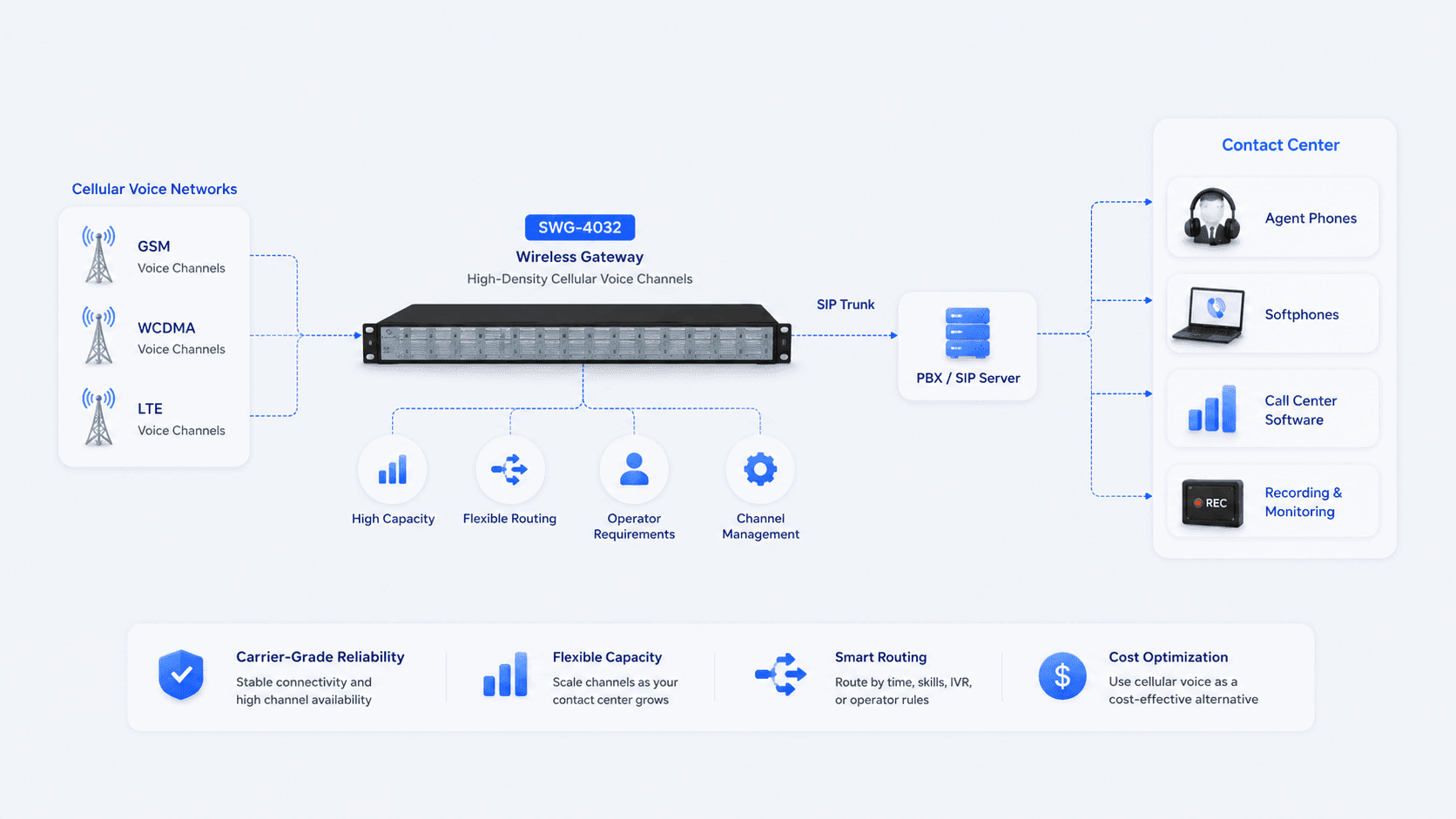
A contact center may require approved mobile network voice channels for a defined inbound, outbound, regional, or backup calling need.
The design must align channel capacity, call routing, SIP interoperability, mobile coverage, and carrier policy without relying on gray-market traffic practices or guaranteed connection outcomes.
Route defined inbound cellular calls to the PBX or SIP platform.
Present an authorized mobile network route for selected outbound traffic.
Use local carrier access where service and regulatory design allow.
Evaluate cellular channels as a backup route for specified calls.
SWG-4032 converts up to 32 approved cellular voice channels to SIP, while the selected PBX or contact center platform remains responsible for queues, agents, and policy.
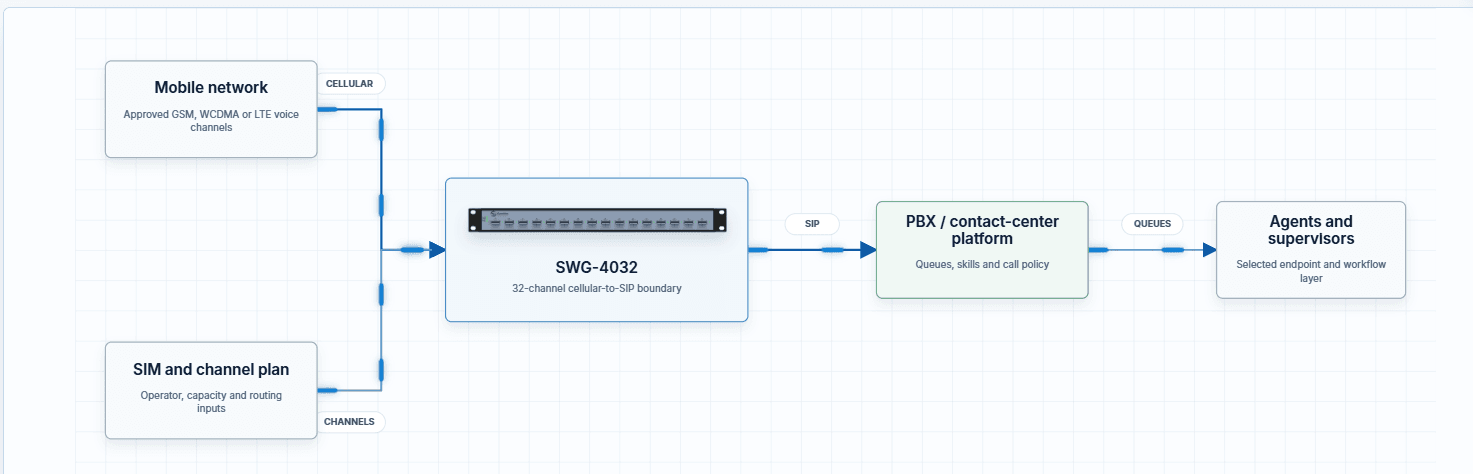
SWG-4032 provides the GSM, WCDMA, or LTE to SIP voice path; the selected PBX and contact center software remain responsible for queues, agents, skills, recording, and monitoring.
No caller ID manipulation, SIM rotation advantage, policy evasion, guaranteed answer rate, or contact center application function is claimed.
SWG-4032G, SWG-4032W, and SWG-4032L provide the documented GSM, WCDMA, and LTE voice roles.
The gateway presents cellular voice to the selected SIP or IP-PBX environment.
Cellular channels can be designed as primary or backup trunks for approved traffic.
Channels, coverage, carrier conditions, routing, and failure behavior are confirmed before deployment.
Share traffic direction, concurrent calls, mobile operators, regions, PBX platform, routing, and backup requirements. OpenVox can help define gateway capacity and validation.
Describe your requirements. Our team can help you select and plan your OpenVox solution.